Eleven notebooks, forty years of a life, sitting in a wardrobe and fading. This is what I found in my grandmother's diaries, and how I saved them before it was too late by learning to digitize old diaries.
The box was at the back of a wardrobe in my grandmother's old house, tucked behind winter coats and a broken umbrella. Inside were eleven notebooks, spanning 1968 to 2009. Some had elastic bands around them that had dried and cracked. One had water damage along the bottom edge. All of them were fading.
I sat on the floor and read for two hours without moving.
Her voice was so clear on those pages. The small worries, the dry observations, the tenderness she rarely showed in person. I read about the year my mother was born, about a summer holiday I'd heard stories about all my life, about small joys and quiet struggles she never spoke of aloud. It was, without question, the most intimate portrait of her I had ever seen.
And I realized, sitting there, that I had almost lost it. Another decade in that wardrobe and some of those pages would have been illegible.
Paper doesn't last forever
Most of us don't think about this until we're holding something fragile. Standard paper, especially the kind used in inexpensive notebooks, begins to yellow and become brittle within decades. Ink fades. Humidity warps pages. Sunlight bleaches them. And none of this happens dramatically, it happens slowly, quietly, until one day you hold a page up to the light and realize you can no longer make out certain words.
Digitizing is the simplest way to stop that clock.
How to photograph old documents well
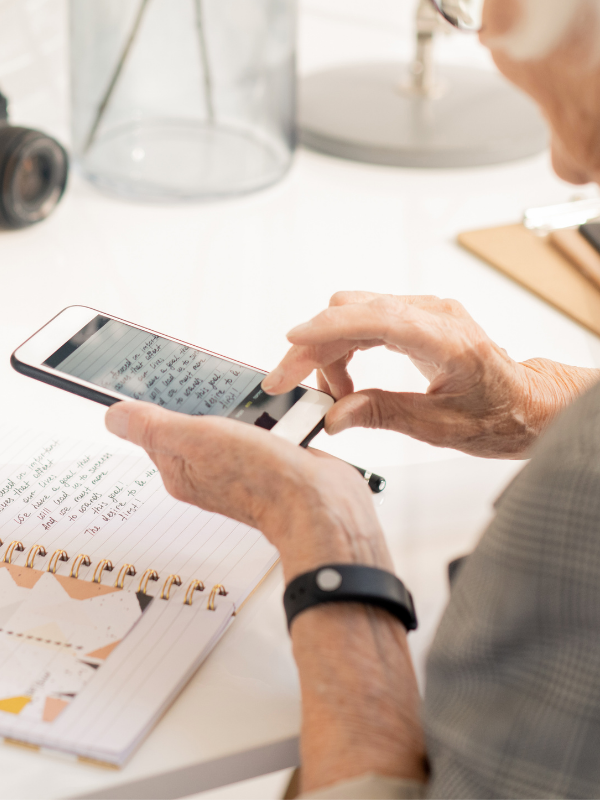
You don't need specialist equipment to get started. A smartphone camera is enough for most purposes. The key is good, even light, a bright overcast day near a window is ideal. Hold the camera directly above the page, not at an angle, and photograph each page individually. The built-in document scanner in iPhone Notes will automatically straighten and sharpen each image.
If the handwriting is faint or the pages are delicate, a flatbed scanner gives much better results. The light source is even, there's no risk of shadows, and the resolution is high enough to capture every detail, including the faint impressions of old pen strokes that cameras sometimes miss.
Once photographed, organize the images by notebook and date. A folder called "Grandma's Diaries / 1968" is enough. You don't need a perfect system. You just need one you'll actually maintain.
Making the text searchable
This is where things get quietly remarkable. Apple's Live Text feature can read handwritten text from photographs, tap on any image in your photo library and the text becomes selectable. For older, more irregular handwriting it isn't always perfect, but even partial recognition means you can search your entire archive for a name, a place, or a year. There is a whole workflow for how to scan handwritten journals so the text is searchable, and it is worth following if the writing is faint.
Imagine searching forty years of your grandmother's diaries for the word "hope."
Turning 40 years of diaries into something you can hold
Once you have a digital archive, you have options. The simplest is to keep it in iCloud, organized and searchable, something you can open on a quiet evening and read from wherever you are in the world.
But many people want to go further and turn old memories into a book. A printed book, made from the digitized pages and photographs, becomes something you can give to the rest of the family. Something that sits on a shelf and gets passed down. Services like Blurb let you design and print a hardcover book from your own images, and the quality is genuinely beautiful.
A printed copy of someone's life, made with care, is one of the most meaningful gifts you can give to the people who loved them.
For the originals, acid-free archival sleeves and storage boxes slow the physical deterioration significantly. They're worth having alongside the digital version, because sometimes people want to hold the actual thing.
Start before you mean to
The reason most people don't digitize old documents is the same reason they don't do many important things: it feels like a project, and projects feel like they require the right moment. They don't. An afternoon is enough to get through a small collection. A weekend is enough for something substantial.
The right moment is now, while the documents still exist in a form worth preserving.
The other thing that happens, once you have read a lifetime of someone's diaries, is that you want to keep one yourself. YearDiary is a private digital 5 and 10 year journal for iPhone, iPad and Mac, and it shows you what you wrote on the same date 1, 5 and 10 years ago.
I finished my grandmother's diaries two months after I found them. The digital archive lives in iCloud. A printed book sits on my shelf. And eleven fragile notebooks are stored in an archival box, preserved as well as I know how to preserve them.
I think about what would have happened if I'd put the box back in the wardrobe and told myself I'd deal with it later.